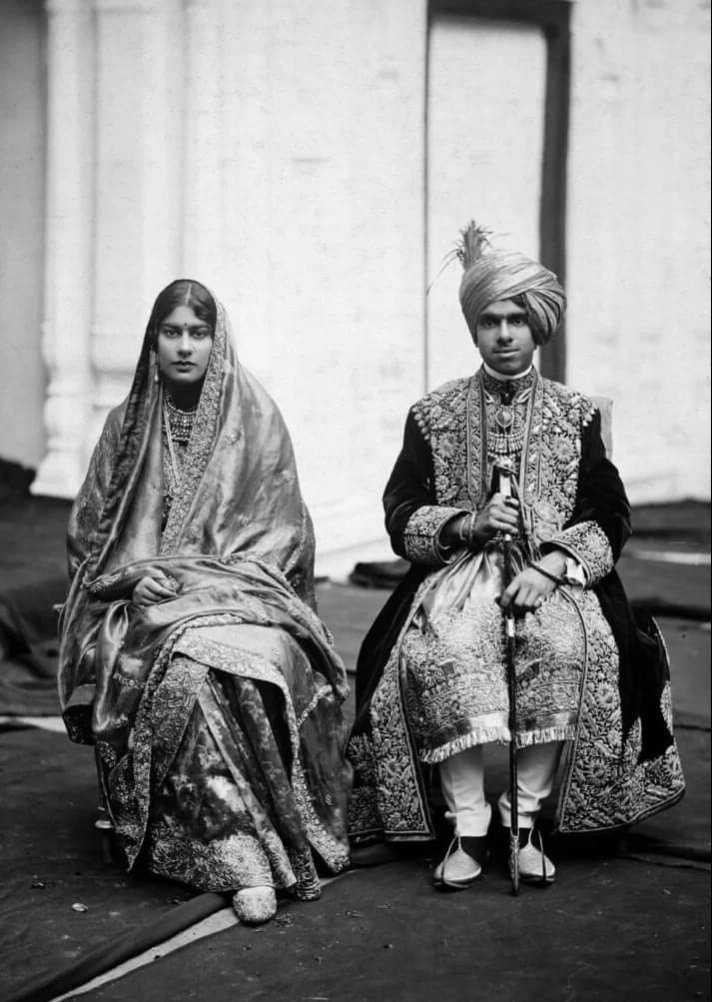
I recently finished In Search of Amrit Kaur by Livia Manera Sambuy, and I have been thinking about the Rani of Mandi ever since.
Some books stay with you because of the writing. Some because of the person they introduce you to. This one did both for me. Sambuy writes with the curiosity of someone following a ghost through archives, letters, rumours, old photographs and half-remembered family stories. The book doesn’t feel like a straightforward biography. It feels like a search. And perhaps that is why Amrit Kaur herself feels so alive by the end of it: not like a polished historical figure, but like a woman who was difficult, brave, contradictory, wounded, glamorous, principled and impossible to fully contain.
We talk a lot now about living authentically, about choosing ourselves, about not shrinking to fit other people’s expectations. Sometimes these ideas can sound almost too easy, as if freedom is just a matter of moving cities, changing jobs, buying better clothes, curating a better life.
But Amrit’s life reminds you that real freedom is rarely aesthetic. It is rarely clean. Sometimes it comes with grief and also asks you to leave behind people and places you still love. Sometimes it costs you your comfort, your reputation, and even the version of yourself other people understood.
That is what I found so moving about her. She didn’t just want a beautiful life. She wanted an honest one.
The World She Was Born Into
To understand Amrit’s rebellion, you have to first understand the strange world she came from.
She was born into the princely world of British India, where royalty lived surrounded by enormous wealth, ritual and display, but under the watchful shadow of the British Empire. The princes had palaces, jewels, servants, titles and ceremonies, yet much of their real political power had already been hollowed out. What remained was spectacle and a delusional performance of some sort.
Sambuy describes this world through images of “ruby-studded balls” and “golden toys,” and that phrase stayed with me. It captures the absurdity and sadness of it so well: a world overflowing with luxury, but not necessarily meaning.
For women, that world must have been even more suffocating. A princess or a queen was expected to represent the family, preserve honour, behave beautifully and remain loyal to the structure that held her in place. Her value was often in how well she represented the system, not in how freely she thought.
Amrit was born into that world, but she never seemed fully seduced by it.
She had been educated in England and France, played tennis, led an all-girl jazz band. She was stylish, intelligent, curious and exposed to ways of living that were far beyond the expectations of a Himalayan court. I imagine that once you have seen another kind of life, it becomes very difficult to return to your assigned role without questioning it.
That, to me, is where her rebellion begins.
Not with one dramatic act, but with the private realisation that the life handed to her was not necessarily the life she had to keep.
Leaving Familiarity Behind
Reading about Amrit’s move from Mandi to Paris made me think about the relationship between place and identity.
Living in London has changed me in ways I probably still don’t fully understand. There is a freedom here that I deeply value: the freedom to walk through the city alone, to spend an afternoon in a museum, to sit in a café with my thoughts, to build a home around my own rhythms. Some evenings, being at home with Vincent, my cat, feels like the safest and most peaceful thing in the world. On other days, the city itself gives me space to breathe.
But I don’t want to romanticise leaving. Because leaving is painful.
I know what it feels like to leave behind a life you spent decades building. I left my family, my dog, my friends, the streets I knew, the language of home, the routines that made sense without explanation, or in simple terms, I left behind familiarity. And familiarity, even when it is limiting, has its own kind of tenderness.
There is a grief in that. A real one.
People often talk about moving abroad or starting again as if it is only exciting. It is exciting, of course, but it is also lonely. You are constantly translating yourself, not just through language, but through culture, humour, memory, food, habits, and history. You realise how much of who you are was held by the people and places around you.
Still, sometimes you have to leave. Not because the old life had no love in it. Not because you are ungrateful.
But because something inside you knows that staying would mean slowly becoming less honest with yourself.
For Amrit, Paris was not just a city. It was a way of becoming. Away from Mandi, away from royal expectations, away from the suffocation of her marriage, she had the chance to exist differently. She could be more than a wife, more than a queen, more than a symbol of someone else’s kingdom.
She could become herself.
And perhaps that is what identity really is. Not something you inherit once and keep forever, but something you keep making, choice by choice, city by city, loss by loss.
The People We Choose
One of the parts of the book I loved most was the attention it gives to Amrit’s friendships.
Her bond with Anita Delgado, the Spanish-born Rani of Kapurthala, is especially fascinating. Both women were, in different ways, outsiders inside royal India. They knew what it meant to be admired and displayed, but not necessarily understood. They occupied beautiful rooms that could also become cages.
Later, in Paris, Amrit built a different kind of life around artists, intellectuals, refugees and friends. Not a family defined by blood or title, but by affinity. By shared values. By affection.
That moved me because I understand, in my own small way, what it means to build a chosen family.
My life in London is held together by the people I have consciously welcomed into it. Friends who have become family to me in the ways that matter most. They are the people who make this city feel less temporary, less anonymous, more like a life.
Even my work as a barista has given me a kind of community I didn’t expect. There are customers I see more often than some relatives. Conversations begin with coffee and slowly become something warmer. You learn people’s routines, their moods, the small details of their lives. It is ordinary, but it is not meaningless.
Maybe adulthood teaches you that family is not only something you come from. Sometimes it is something you make.
The Choice that Cannot be Simplified
In 1933, after her husband took a second wife, Amrit left her marriage and settled in Paris.
She left the palace and the role expected of her. Most painfully, she left her two children.
This is the part of her story that cannot be softened, and I don’t think it should be. It would be too easy to turn Amrit into a perfect feminist heroine, a woman who simply chose freedom and never looked back. But real lives are not that neat.
Leaving must have cost her something. Perhaps more than we can know.
There is no way to talk about her freedom without also talking about the pain attached to it. She did not just walk away from oppression. She walked away from a whole life, including parts of herself that could never be untouched by the decision.
And yet, I find myself resisting the easy judgment of her, too.
History has always demanded impossible things from women, and it does today as well. It asks them to endure quietly, to sacrifice completely, to remain graceful under humiliation, and then condemns them if they choose themselves. Men leave families, countries and marriages all the time and are often called adventurous, ambitious or complicated. Women do it and become selfish.
Amrit’s decision was not simple. That is exactly why it feels human. She was not a saint or a symbol. She was a woman in an impossible situation, trying to save some essential part of herself.
Sometimes freedom is not a triumphant door opening. Sometimes it is a wound you choose because the alternative is disappearing.
Freedom as a Practice
What I found most interesting about Amrit’s life is that freedom did not end with leaving.
That is something I have been thinking about a lot.
We often imagine freedom as a destination. Once we leave the wrong relationship, the wrong job, the wrong city, the wrong version of ourselves, we think we will arrive at this perfect state of peace. But life rarely works like that.
Leaving only gives you the chance to choose differently. It doesn’t remove loneliness or erase responsibility or protect you from fear. It doesn’t mean everything suddenly becomes easy.
For Amrit, Paris was not the end of the struggle. It was simply the place where she could decide which struggles were worth carrying. That feels important. Real freedom is not just doing whatever you want. It is living in a way that feels aligned with your conscience, even when it is inconvenient, even when it makes life harder, even when nobody understands.
That is much rarer than rebellion for the sake of rebellion. And Amrit, for all her glamour and restlessness, seemed to have that quality. She kept choosing according to some inner compass.
When Compassion Becomes Courage
The most powerful part of Amrit’s story, for me, comes during the Second World War.
When the Nazis occupied Paris, Amrit could have tried to protect herself. She still had royal connections with access to worlds of privilege. She could have disappeared into safety, or at least attempted to.
Instead, she helped Jewish friends escape. She sold her jewellery to do it.
That image has stayed with me: the jewels of a former princess being transformed into survival. Diamonds, emeralds, necklaces, all the symbols of the life she had left behind, exchanged for train tickets, documents, escape routes, another person’s chance to live.
There is something incredibly moving about that. She took the objects that once represented status and turned them into acts of love.
In 1940, she was arrested by the Gestapo.
At that point, her rebellion was no longer just personal. It was moral. It had moved beyond the question of how she wanted to live and become a question of what she was willing to risk for others.
That is what makes her story stay with me. Amrit not only rejects the cage built around her. She used what remained of that cage to help other people get free.
Why Her Story Matters
History usually remembers the loudest people: kings, generals, politicians, men who signed papers and declared wars and claimed nations. Women like Amrit are easier to lose. Their lives sit in letters, rumours, family archives, old photographs, fragments.
Maybe that is why Sambuy’s book feels so necessary. It restores a woman who could have been forgotten.
But more than that, it asks what kind of lives we consider worth remembering. Amrit did not rule a country. She did not lead a movement in the obvious sense. She did not become a household name.
Instead, she made a series of private choices that became quietly radical. She questioned royalty, left a marriage, built a new life by choosing her own people. She risked herself for her friends.
There is something deeply modern about that, even though her world was so different from ours.
Because most of us are also trying, in our own ways, to live inside systems that tell us who to be. Family systems. Cultural systems. Class systems. Gendered expectations. Immigration systems. Work. Money. Respectability. Fear.
The cages look different now, but they still exist.
Our own Quiet Revolutions
When I finished In Search of Amrit Kaur, I didn’t feel like the book was asking me to admire her from a distance.
It felt more intimate than that.
It made me think about the choices we make when nobody is watching. The little betrayals of self we accept because they are convenient. The dreams we postpone because they would disrupt us too much. The relationships we remain in because leaving would hurt. The cities we stay in because they are familiar. The versions of ourselves we keep performing because other people are comfortable with them.
Most of us will never flee a palace. Most of us will never be arrested by the Gestapo.
But we all know what it means to feel the gap between the life we are living and the life that feels true.
Our rebellions are usually smaller. Leaving the place that no longer allows us to grow. Ending the relationship that makes us shrink. Changing the work that drains our spirit. Building family through friendship.
Choosing kindness when bitterness would be easier. Choosing honesty, even when it disappoints people. Choosing a life that feels authentic, even when the cost is high.
Amrit’s story is not inspiring because she had no fear. I am sure she had plenty of it. It is inspiring because she kept moving towards the life that felt true, even when that truth came with loss.
And maybe that is what living on your own terms really means. Not escaping pain or designing a perfect life or becoming someone untouchable.
But having the courage to build a life you can recognise as your own.