At the Schiaparelli exhibition at the V&A, I kept returning to the shoe hat.
It is exactly what it sounds like. A woman’s shoe turned upside down and worn on her head, with the heel rising above her forehead, designed by Elsa Schiaparelli with Salvador Dalí in 1937.
Nearly ninety years later, displayed behind glass in a museum, it doesn’t look ridiculous. It looks witty and strangely assured. But the museum has already told us how to see it. We know Schiaparelli was important and that the shoe hat survived to become one of the objects most closely associated with her.
I tried to imagine seeing it before any of that was known.
Someone had to suggest putting a shoe on a woman’s head and then continue taking the suggestion seriously. It had to be drawn, made and included in a collection. Eventually, a woman had to agree to wear it. There must have been a moment when it was simply an absurd idea.
I think this is what stayed with me throughout the exhibition. Schiaparelli had ideas that could easily have remained jokes or private images inside her head, but she made them real. She gave them materials, shape and a body to live on.
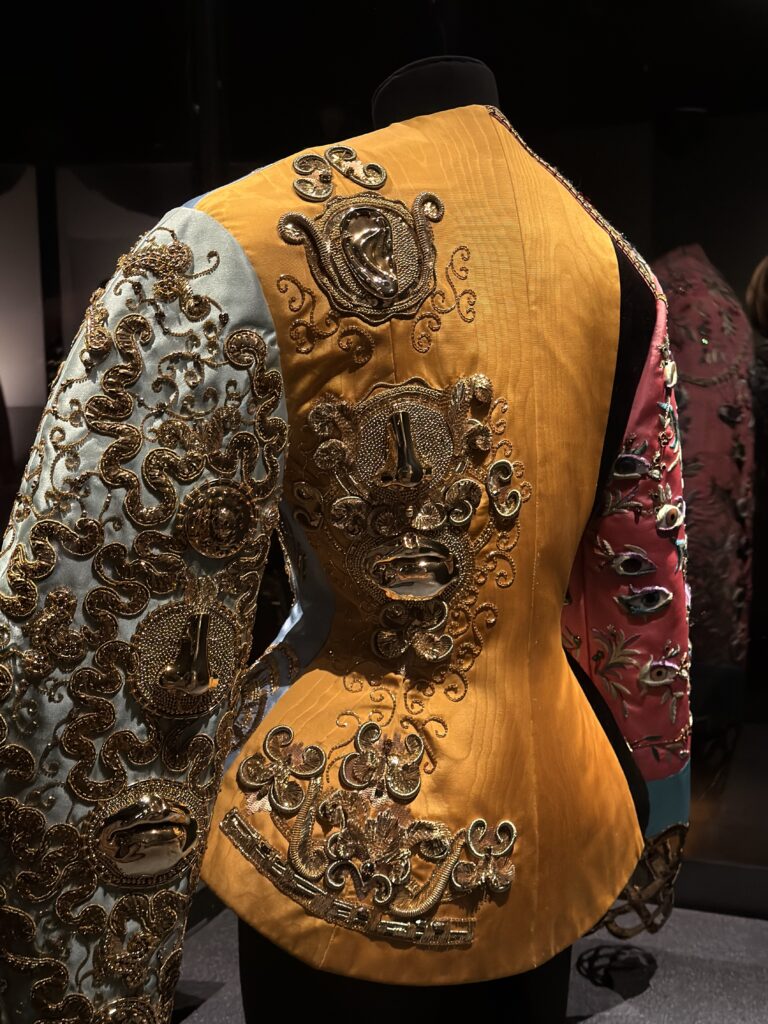
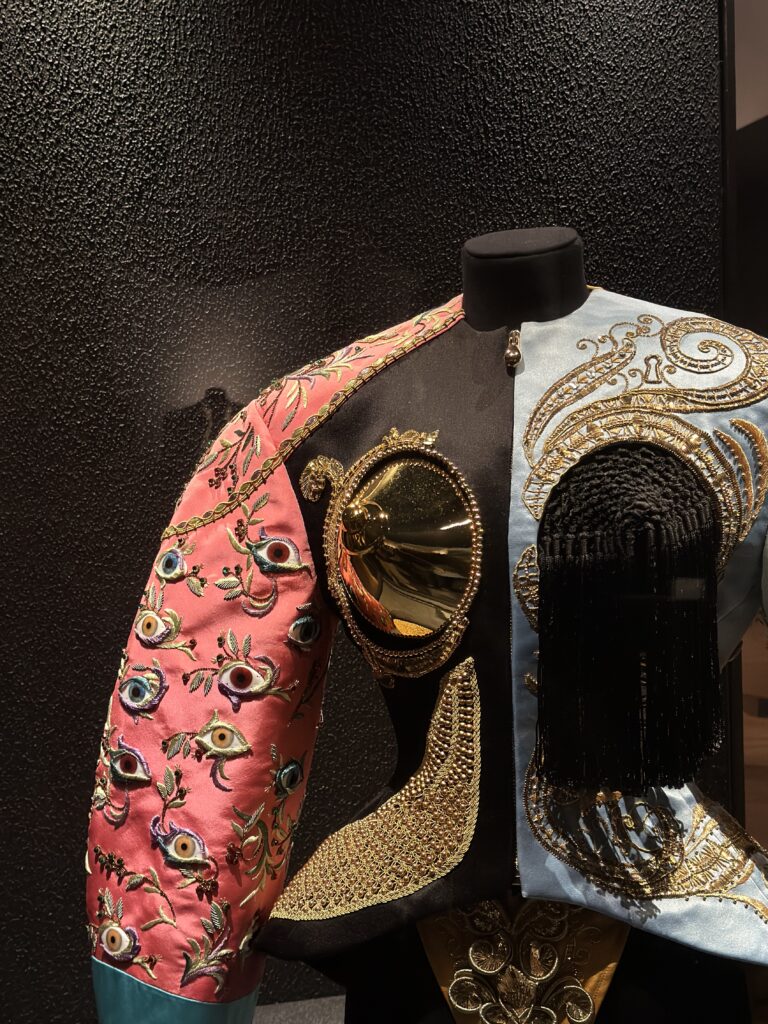
There were buttons that looked like tiny sculptures, jackets with enormous pockets and silhouettes that altered the proportions of the women inside them. Ordinary parts of clothing refused to behave ordinarily. A fastening did not need to disappear; a pocket could take over a jacket. A woman’s body could become the place where several different images existed at once.
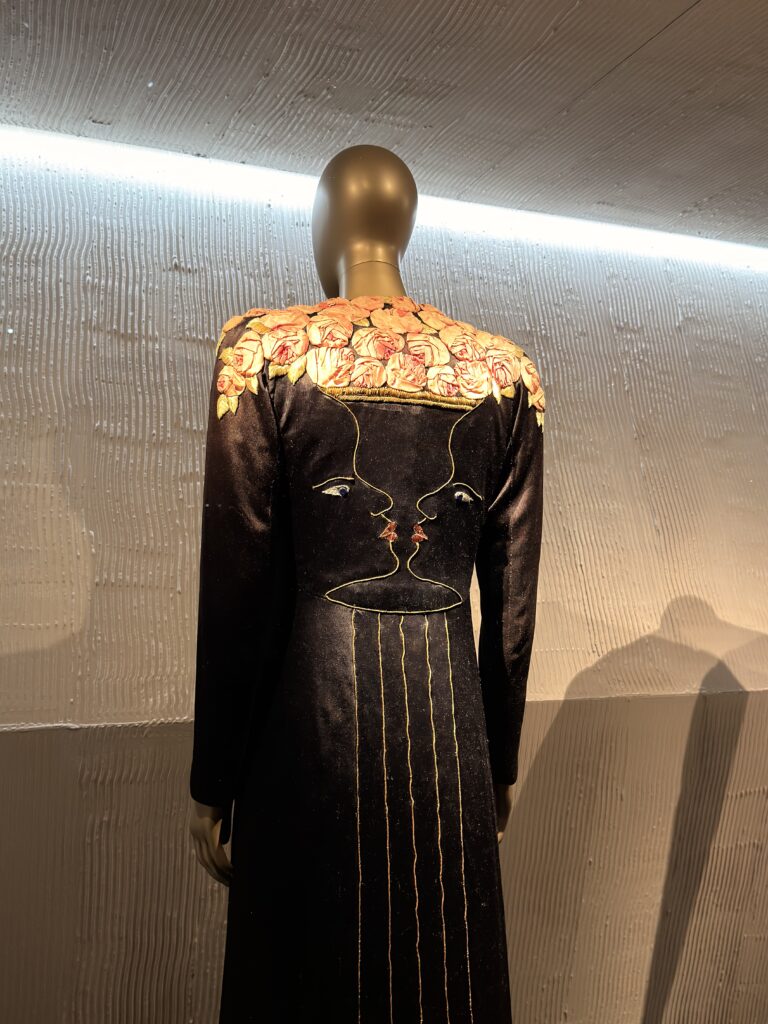
On an evening coat designed with Jean Cocteau, two faces in profile approach each other across the wearer’s back. The space between them forms a vase, with pink roses spreading across the shoulders. I saw the faces first. Then I found the vase. After that, I couldn’t look at one without seeing the other.
I wondered where a mind like that begins.
When Schiaparelli was a child, she believed that her older sister was the beautiful one. Wanting to become beautiful herself, she put flower seeds into her mouth, nose and ears. She imagined them growing across her face “like a heavenly garden”—nasturtiums, daisies and morning glories blooming from her body.
The seeds nearly choked her.
It is a frightening story, although the image is so beautiful that I initially forgot the danger. It is sad too. This was a child who had already decided that her face needed to become something else.
But her solution was entirely her own. She didn’t simply wish to look like her sister. She wanted to turn herself into a garden.
It would be convenient to treat this as the beginning of everything Schiaparelli later became. The flowers could fail to grow from her face and then reappear in her clothes. A childhood fantasy could become the explanation for an entire career.
But I don’t know if a life works like that, or how often Schiaparelli herself returned to the memory. Perhaps she understood it differently as she got older. Perhaps it was simply one strange thing she had done as a child.
Still, while walking through rooms filled with flowers, skeletons, faces and animal forms, I kept thinking about the girl with seeds inside her mouth. Even then, the body did not seem fixed to her. It was something she might transform if she could only work out how.
Similarly, her fashion career began with another moment of curiosity.
In 1927, Schiaparelli admired a friend’s hand-knitted sweater and learned that Armenian knitters had made it. She found them and commissioned a sweater of her own. Across the front, she wanted a bow that looked almost like a child’s imperfect drawing. The bow wasn’t attached. It was knitted into the fabric as a trompe-l’œil illusion. From a distance, it appeared to sit on top of the sweater, although the surface was completely flat.
Schiaparelli wore it herself. People noticed it, buyers wanted it, and the sweater became her first major success.
I like that this story begins with her seeing something made by someone else. It makes her creativity feel less like an extraordinary gift descending from nowhere. She noticed a sweater, asked who had made it and went looking for the people who possessed the skill she needed. Then she asked them to make the version she could see in her head.
She wore it before she knew what other women would think.
Of course, she must have hoped that they would want it. Schiaparelli was trying to build a business and had a daughter to support. It would be dishonest to present her as an artist entirely unconcerned with money, reputation or attention. She wanted her clothes to sell.
The interesting thing is that selling them did not require her to remove their oddness. The oddness was what people bought.
After the sweater came exposed zips, enlarged shoulders and buttons resembling insects, vegetables, acrobats and parts of the body. Schiaparelli worked with Dalí, Cocteau, Man Ray, Leonor Fini and other artists. But the garments were not simply paintings transferred onto fabric. A person had to enter them, move in them and become part of whatever illusion had been created.
The Cocteau coat depends on the shape of a body inside it. Without the wearer’s back, the two faces do not approach each other in quite the same way, and the vase between them loses its form. The roses spread across the shoulders almost like something growing from the woman herself.
The clothing changes the body, but the body completes the clothing.
Even Schiaparelli’s practical designs refused to become unremarkable. One jacket in the exhibition had large embroidered “cash-and-carry” pockets, created as part of a wardrobe for her American lecture tour in 1940. The pockets were intended to hold the things a woman might need while travelling.
Another designer might have concealed that function within the construction of the garment. Schiaparelli enlarged and decorated it until the pockets became impossible to ignore.
I found myself smiling at them. They were useful, but they were also slightly ridiculous. Maybe Schiaparelli understood that usefulness and absurdity were not opposites.
It is tempting to call her fearless. I am not sure that tells us very much.
We use that word when we can no longer see the fear. The exhibition contains the objects that survived, beautifully lit and accompanied by labels explaining why they matter. It cannot show every idea that failed, every garment that looked wrong or every moment when Schiaparelli wondered whether she had gone too far.
Perhaps she rarely doubted herself. I don’t know, and I have to resist inventing a private uncertainty simply because it would make her easier for me to relate to. It would make for a convenient essay if Schiaparelli had experienced the same hesitation I experience when I write. I could turn the exhibition into a lesson about believing in yourself and claim that every strange idea deserves to be followed.
But plenty of strange ideas are probably just strange ideas.
What I do know is that Schiaparelli made decisions before she could be certain of their outcome. Whatever confidence or doubt existed privately, the work still had to leave her imagination and enter the room. This becomes more complicated in the contemporary part of the exhibition.
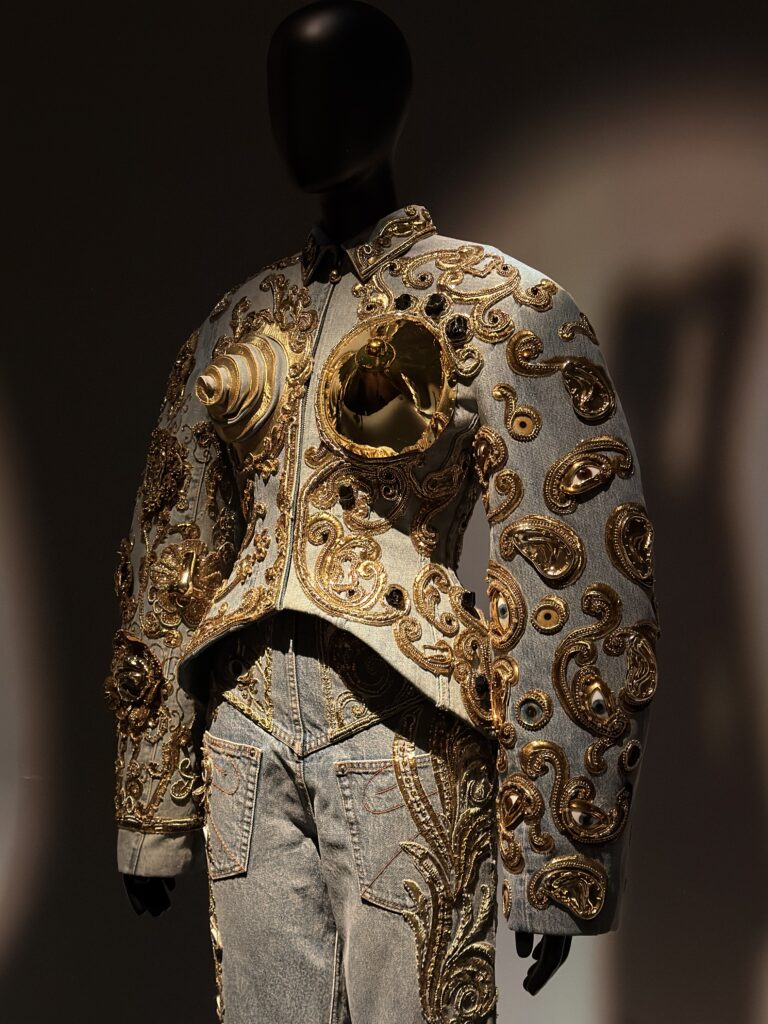
Daniel Roseberry became creative director of Schiaparelli in 2019. He inherited a house whose most recognisable objects had been created by someone else almost a century earlier. There was always a risk that respecting Schiaparelli would mean endlessly repeating her.
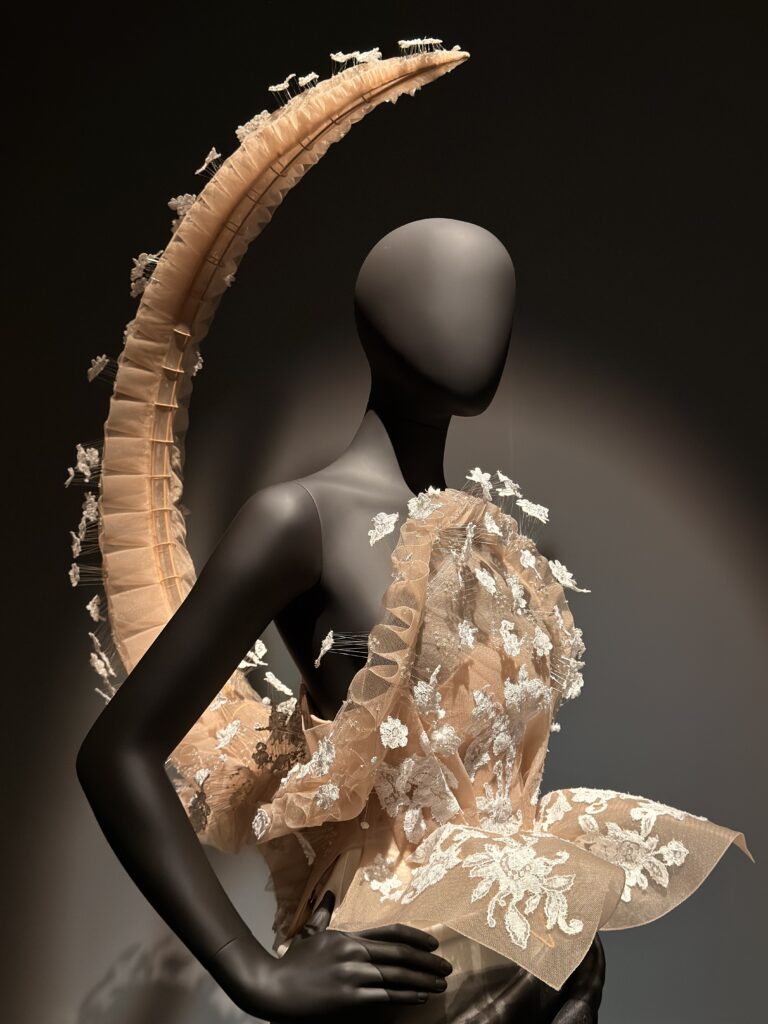
His Scorpion Sisters look extends a delicate lace garment into an enormous tail that curves above the body. Small floral shapes appear to float away from it, held in place by fine needles. It is beautiful, but it also looks capable of hurting you.
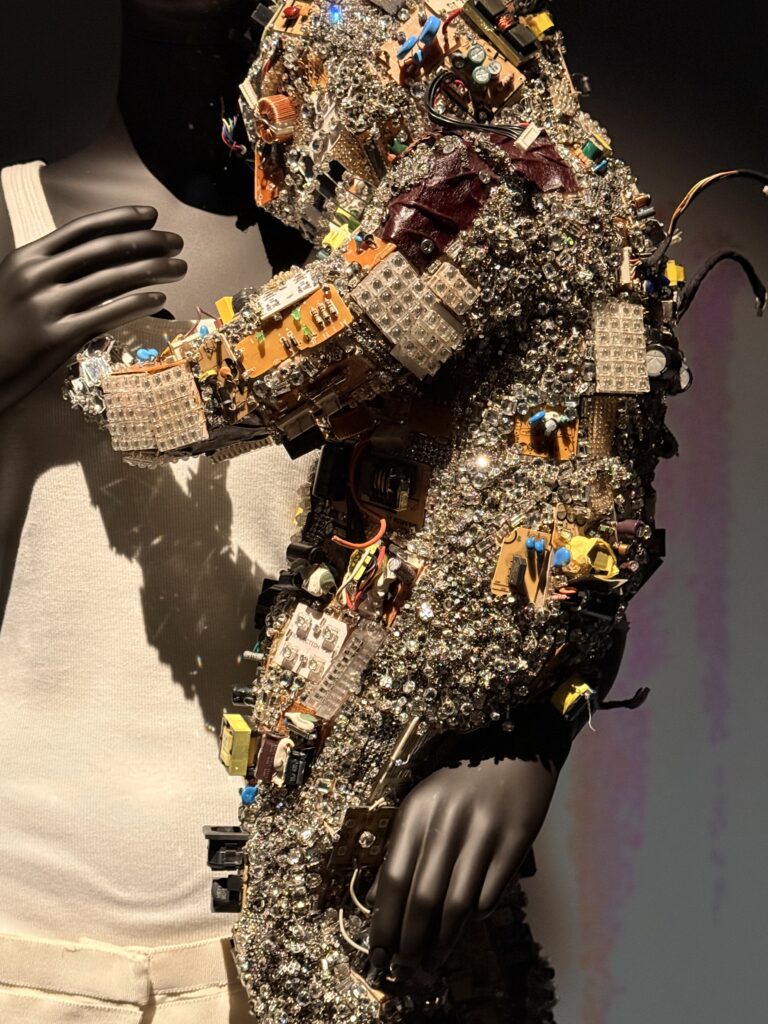
Nearby, a mechanical baby assembled from electronic components, crystals and wires is held against the body with the tenderness given to something alive.
I took one photograph of the full figure and then moved closer to photograph the baby. From a distance, it glittered. Up close, I could see circuit boards, coils, switches and loose wires tangled among the crystals. The mannequin’s hand rested against it gently.
I don’t know why I found that gesture so affecting. Nothing about the baby looked alive, and yet the hand held it as if it required care. Neither of these pieces looks as though Elsa Schiaparelli made it. I think this is why they belong so convincingly inside her house.
Roseberry has not copied the shoe hat or simply reproduced the lobster dress. He seems to have inherited the permission beneath them: the permission to take an image seriously even when it is excessive, unsettling or absurd.
Looking at all of this, I began thinking about writing.
I often doubt whether an observation is original enough to publish. I can believe in an idea when it first appears and then slowly talk myself out of it. Hasn’t somebody already said this? Is it actually interesting? Or am I only making it sound interesting because I want to think of myself as a writer?
The more I ask those questions, the smaller the original thought becomes.
Schiaparelli’s work does not resolve this for me. It doesn’t prove that every instinct is valuable or that doubt should be ignored. But it made me wonder whether I sometimes judge an idea before I have properly discovered what it is.
There is a difference between deciding that something is bad after making it and refusing to make it because it might be bad. I am much more familiar with the second.
I want people to read what I write. Their responses matter to me, sometimes more than I would like. If I published an essay and nobody read it, I would be disappointed. There is no point pretending otherwise.
But would I regret writing it? Probably not.
Finishing an essay gives me something attention cannot quite replace. A thought that existed vaguely inside me becomes clearer. I understand what I was trying to say, or at least I understand it better than I did before I began.
This feels like a small thing, or maybe it isn’t.
Schiaparelli clearly wanted women to desire and buy her clothes. She wanted success, and she achieved it. But before anybody could admire an object, she had to decide that the private image in her mind was worth the trouble of making visible.
Coco Chanel is said to have dismissed her as “that Italian artist who makes clothes.” Schiaparelli herself wrote that dress designing was not a profession for her but an art. The insult and the self-description are almost the same.
What Chanel apparently considered evidence that Schiaparelli did not properly belong among couturiers was the very thing Schiaparelli claimed for herself. She was an artist who made clothes. The category did not need to embarrass her simply because somebody else intended it to.
Before leaving the exhibition, I looked again at the objects with all their authority around them—the dark galleries, the spotlights and the wall text explaining what each one had come to mean.
It was difficult to imagine them without it.
But once, there had been no retrospective. There was a sweater Schiaparelli had seen on a friend, a childhood memory about flowers, a photograph of Dalí balancing a shoe on his head and the practical work of persuading other people to help make these things real.
Some of the ideas must have failed. Others survived long enough for me to stand in front of them nearly a century later.
I still don’t know whether Schiaparelli trusted every instinct she had. I doubt anyone could.
Perhaps she was simply curious enough to find out what happened when she gave an absurd idea a form.
The world could decide what it thought afterwards.